
Digestate & Manure Treatment
As a specialist in digestate and manure treatment and recovery, France Evaporation develops the most efficient and sustainable concentration and recovery solutions on the market. Volume reduction and nutrient recovery: our turnkey, user-friendly plants cut your costs, increase your revenue and get the most value out of your output.
Home > Industries > Digestate & Manure Treatment

A comprehensive recovery solution for a circular economy
Whether you handle digestate from agricultural or industrial anaerobic digestion, or cattle, pig or poultry manure, FE designs concentration and recovery solutions tailored to the nature of your effluents and the constraints of your site.
Our approach is rooted in the circular economy: reducing the volumes to be managed, separating and recovering components with agronomic value, optimising energy consumption and enabling the recovery of every stream produced by the treatment process.
Our plants are flexible and modular, and adapt to your objectives, your investment strategy and your technical constraints (layout, processes, etc.).
90%
average volume reduction
3.5 millions
tonnes of digestate treated per year
+35 years
of proven reliability
From raw digestate to valuable resources. Without compromise.
Digestate is not a single stream to be disposed of, but a resource whose components can be separated, concentrated and recovered.
FE’s solutions are part of a comprehensive approach that combines anaerobic digestion, separation, evaporative concentration, nutrient recovery and energy optimisation. They produce several marketable streams: solid digestate rich in phosphorus and organic matter, concentrated digestate rich in potassium and organic matter, nitrogen fertilisers and clean condensate.
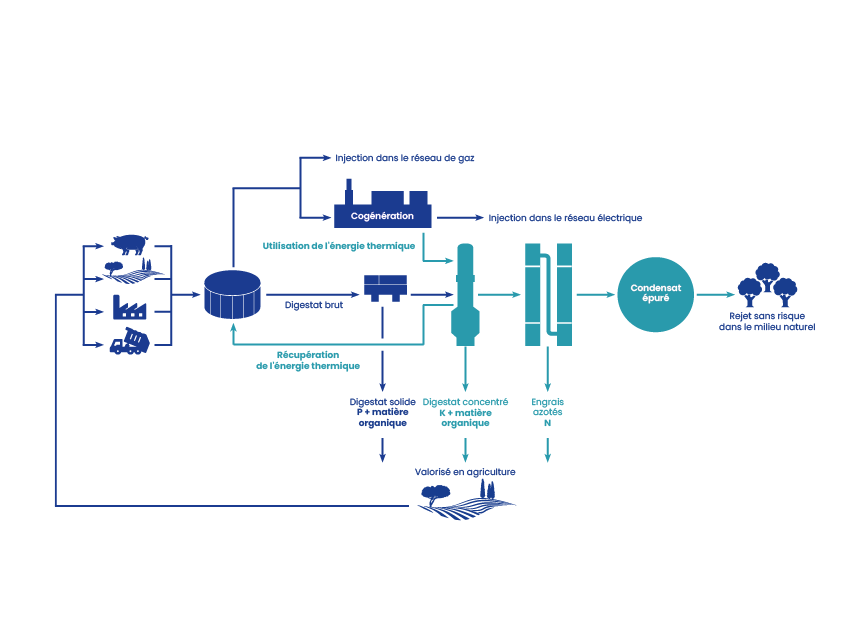
> Objective: reduce volumes while maximizing resource recovery and the overall performance of the plant.
Optimising your digestate management
Managing digestate and slurry has become a major challenge for anaerobic digestion plant operators and the livestock sector. With land available for spreading under growing pressure and regulations becoming stricter, the goal is to reduce volumes while maximising the agronomic and energy value of the effluents.
Digestate recovery rests on three pillars:
Reduce digestate volume
Our evaporation and concentration technologies drastically reduce the volume to be transported, stored and spread, cutting logistics costs and the environmental footprint of the operation accordingly.
Recover nitrogen, phosphorus and potassium
Our processes separate digestate into marketable fractions: solid digestate (phosphorus + organic matter), concentrated digestate (potassium + organic matter) and nitrogen fertilisers (ammonia water, ammonium bicarbonate, ammonium carbonate, ammonium carbamate, ammonium nitrate, ammonium sulphate).
Return clean condensate to the environment
Water recovered at each stage can be reused on site or discharged in full compliance with applicable standards.
> An integrated solution (evaporation, MVR, energy recovery) to treat 100% of your effluents.
How it works: the process step by step
A digestate treatment plant combines complementary technologies and is designed around the nature and volume of your effluents.
Heat from cogeneration (biogas engines) is used to power the concentration process, reducing external energy requirements.
Raw digestate is concentrated in falling film or forced circulation evaporators with mechanical vapour recompression, for maximum energy efficiency.
Solid digestate (phosphorus + organic matter), concentrated digestate (potassium + organic matter), nitrogen fertilisers (nitrogen): each fraction is recycled in agriculture.
The clean condensate is returned to the natural environment or reused on site, in full environmental compliance.
> Raw digestate recovered, clean condensate returned: a circular loop controlled from end to end.
A major step forward in energy efficiency, by FE
By combining MVR (Mechanical Vapour Recompression) technology with high-temperature heat pumps, FE gives waste heat a second life.
This energy, which is usually lost, is recovered, raised in temperature and fed back into the digestate treatment process. It becomes a real driver of performance and energy efficiency for the whole plant.
The system is fully electric and uses no fossil fuels at all. All the biomethane produced by the digester can then be recovered, instead of part of it being burned to heat the process.
Why treat your digestate on site?
A digestate treatment solution puts you back in control of how you manage your anaerobic digestion or livestock effluents. By reducing volumes and concentrating nutrients, it secures your spreading plans and creates new revenue streams (fertilisers, biomethane).
Digestate treatment is a strategic response to the sector’s current challenges:
- the growing scarcity of land available for spreading;
- stricter regulations on nutrient management (nitrogen, phosphorus);
- rising transport, storage and spreading costs.
At the heart of the system, evaporation, mechanical vapour recompression and heat recovery work together towards a clear goal: reduce volume, ensure compliance and maximise the agronomic and energy value of every tonne treated.
Reduce operating costs
Add value to nutrients
Optimise energy performance
Maximise resource recovery
Meet regulatory requirements
Ensure long-term performance
> A flexible, modular design, with mobile units available for hire for trials and short-term needs.
The difference FE
CIRCULAR APPROACH
An integrated solution combining concentration, energy recovery and agronomic recycling.
REGULATORY COMPLIANCE
Secure spreading plans and reduced discharges, meeting the most stringent environmental requirements.
MAXIMUM ADAPTABILITY
Tailor-made solutions, backed by mobile pilot units.
MULTI-SECTOR EXPERTISE
Recognised expertise in agricultural, industrial and municipal anaerobic digestion, and in livestock farming.
EASY OPERATION & MAINTENANCE
Fully automated units, maintenance included.
COMPACT UNITS
Fits on any type of site, with no environmental nuisance.


