Stripping

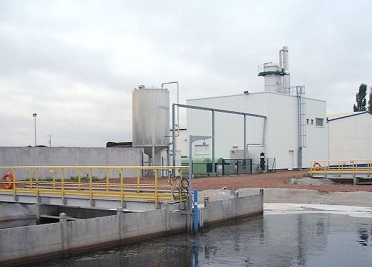
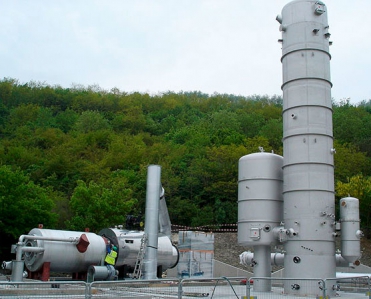
Stripping (also referred to as distillation) enables solvent separation. This technology is commonly used alongside an evaporation unit to strip solvents from produced condensates.

FE by France Evaporation designs and delivers distillation and stripping systems dedicated to the separation and concentration of ethanol and ammonia for industrial sectors including chemicals, food & beverage, pharmaceuticals, and energy. Our technologies optimize process purity, yield, and energy performance while meeting regulatory and environmental requirements.

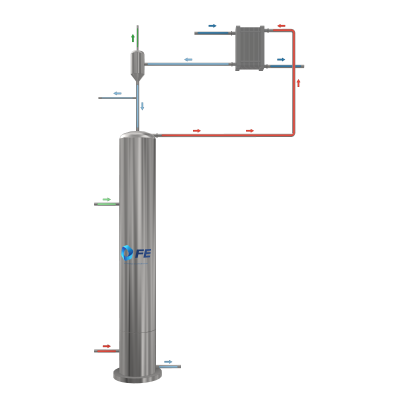
15 Stripping - 3D-Front
Stripping unit — 3D view

The most common applications involve the separation of ammonia or alcohols, with the objective of improving condensate quality.

FE Icon

Optimizing the energy efficiency of stripping

Stripping requires steam to separate the volatile component from the product. Several technologies are available to reduce the energy consumption associated with this process.

Depending on your project, target capacity, and local energy costs, France Evaporation will assist you in selecting the most suitable technology to minimize operating costs and capital expenditure.

Energy recovery above 100°C as hot water to feed the stripping unit

Where an energy source above 100°C is available on site, it is recovered and transferred as hot water, then flashed to generate steam and supply the stripping unit.

Mechanical Vapor Recompression (MVR)

A patented technology developed by France Evaporation, this configuration combines a stripping column, an MVR compressor, and a heat exchanger to significantly reduce steam consumption and optimize operating costs.

Thermo-Compressor

A thermo-compressor may also be used as an alternative to Mechanical Vapor Recompression (MVR).

FE Icon

olvent Outlet Management: the Case of Ammonia

The stripped solvent (e.g. ammonia) can be managed in several ways:

  • production in concentrated form
  • solvent destruction by oxidation
  • use for DeNOx applications
  • production of a salt (ammonium sulfate)
FE Icon

Ammonium sulfate production and other saline solutions

An inline reactor can be integrated with the stripping unit to produce a saline solution in liquid form. In the case of ammonia, for example, FE by France Evaporation offers direct salt production in liquid form at the stripping unit outlet.

For instance, ammonium sulfate can be produced directly at the stripping outlet in order to:

  • recover it as a fertilizer
  • obtain a stable product that is easier to store
  • access a broader resale market for the solution
  • manage the acid-base thermal reaction directly within the unit

FE Icon

References

Ref_sodium sulfate crystallization_France 2

Sodium sulfate crystallization

  • World's first IFC® installation
  • Sulfate discharge reduction
Ref_sodium pentaborate crystallization_Turkey 2

Sodium pentaborate crystallization

  • Largest crystallization line installed on site
  • Largest D50 on the market
[Ref_potassium sulfate crystallization_Singapore 2

Potassium sulfate crystallization

  • By-product valorization
  • Tropicalized environment
Ref_ammonium sulfate crystallization _China 1

Ammonium sulfate crystallization

  • Zero Liquid Discharge (ZLD)
  • Discharge volume reduction
  • Recovery as fertilizer
[15E434] Ref_Ammonium sulfate crystallization_Turkey 2

Ammonium sulfate crystallization

  • Ammonium sulfate purification
  • Metallic impurities filtration
[24E637] Ref_cSodium Sulfate Crystallization_Sweden 4

Sodium sulfate crystallization

  • IFC® crystallizer for battery recycling
  • Reduction in effluent flow
  • Minimum Liquid Discharge (MLD)